
We write a lot about how StoryMachine addresses issues inherent in traditional folklore archives: difficulty of access, discrete collections, and a lack of interactivity. But what are these archives actually for or, in other words, what do folklorists do with them?
This is exactly the question that the project team discussed recently. It is easy to imagine a folklorist going to a community and recording that community’s oral narratives and practices, from bedtime stories to well-dressing. While this kind of collecting is immensely valuable, it forms only a fraction of the research undertaken in the field of folkloristics. Folklore can be used to understand community concerns, track environmental changes, inform policy, and much more.
Folktales Can Tell Us about Environmental Change
In 1987, Darwin Horn published a paper titled ‘Tiddy Mun’s Curse and the Ecological Consequences of Land Reclamation’ in the journal Folklore. Tiddy Mun, or Little Man, is a figure of Lincolnshire folklore, recorded by Marie Clothilde Balfour in the north of that county at the end of the 19th century. He is the size of a toddler, white-bearded, dressed in grey, and has a laugh like the cry of a peewit (lapwing). He lives in the flooded carrs of the Ancholme River valley and is interpreted by Katharine Briggs as an aquatic fertility spirit.
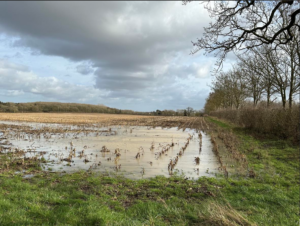
His story goes something like this: in bygone days, people would honour Tiddy Mun. Whenever there was a flood, they would gather at the New Moon and call out across the watery landscape: “Tiddy Mun wi’-out a name, tha watter’s thruff!” The next morning, the water would recede. The folk lived with an understanding that while they shared the flooded fens with Tiddy Mun, he would protect them from harm.
But in the second half of the 18th century, the carrs and fens across Lincolnshire were drained to make way for agricultural land, and the folk stopped propitiating Tiddy Mun. This had disastrous consequences: the carr-folk’s animals went lame and sickened, the children fell ill, the milk curdled, the thatched rooves fell in and the walls burst. Desperate for some relief, the carr-folk appealed to Tiddy Mun again. On the New Moon, each family brought a pail of water, poured it into the dyke and called out, “Here’s watter for thee, tak‘ tha spell undone!” After that, things gradually got better, and the carrs thrived again.
Horn takes the specificity of the ills that befell the carr-folk after the drainage as evidence that the folktale described real consequences of land reclamation:
Why would the cattle pine, pigs starve, ponies go lame, lambs waste away, and new milk curdle as a consequence of land reclamation? It is suggested here that drainage affected the condition of the livestock by altering the pattern of disease and by stimulating changes in feeding.
Drainage can cause a change in disease pattern by altering the chemistry and texture of the soil and ground water, as well as the natural pattern of marsh vegetation. One of the strategies involved in the reclamation of Lincolnshire was the construction of a sluice at the mouth of the Ancholme River, which prevented brackish water from the Humber estuary from inundating the valley during periods of high tide. This altered the chemistry of the soil by making it more acid, and would facilitate the increase in incidence of at least one livestock disease, Johne’s Disease.
Horn continues that change in diet would also lead the livestock to waste or fall ill, that the rapid drying of the soil would cause the cottage walls to subside, and the ponies to go lame. The drop in water levels would initially lead to an increase in disease-carrying insect populations, resulting in greater levels of infection in humans. As the ecosystem shifted, a new balance emerged and things stabilised again.
Horn notes how the story of Tiddy Mun offers ‘insight into some of the ecological consequences of land reclamation. This insight is of particular interest because it describes the events following land drainage from the perspective of the largely illiterate fen-dwelling population whose viewpoint is not often included in standard historical sources.’ Not only does ‘Tiddy Mun’ bring to light the effects of drainage in Lincolnshire, it also gives an example of how communities respond to environmental shifts through stories which can be applied elsewhere.
Darwin Horn’s full paper is available on JSTOR: Darwin Horn. “Tiddy Mun’s Curse and the Ecological Consequences of Land Reclamation.” Folklore 98, no. 1 (1987): 11–15. http://www.jstor.org/stable/1259396.
Folklore Can Inform Our Engagement with History
To situate the relevance of folkloristics in the 21st century, Claire Slack, a PhD student at the University of Hertfordshire, studies the role and visible presence of spiritual belief at British historical sites. Prehistoric monuments like Stonehenge and Avebury have long been important tangible connections to our past, but also sacred sites for modern pagans. The negotiation of the sites’ mixed status has not been without tension (just search ‘Battle of the Beanfield’!). Slack looks at engagement with readily recognisable sites like Avebury Stone Circle, Coldrum Long Barrow, Glastonbury Tor and All Cannings Long Barrow, and poses crucial questions:
- Who should get access to these landscapes and how? What kind of information should be made available to guide that access?
- How do we navigate the tension between environmental conservation, historical importance, and spiritual value in places like Avebury?
- How should the results of folk activity be treated: are ribbons tied at wishing wells sacred offerings, rubbish, or archaeological artefacts that belong in a museum?
Slack conducts ethnographic studies using folklore as a lens through which her respondents approach these significant sites.
Claire Slack is also a Project Engagement Officer at the Wiltshire Museum. Her profile can be found here: Claire Slack – Wiltshire Museum
Folklore Offers a Way to Communicate Complex Concepts
Folktales are not only valuable in themselves, they can also be useful tools for understanding. Instinctive familiarity is a central feature of folklore: while it is notoriously resistant to definition, we can generally recognise whether something is a folktale or not. The same logic can be applied to how things work in folktales. This familiarity is used by Luca Viganò to explain key cybersecurity terms. To explain Multi-Factor Authentication (MFA), he invites us to consider Cinderella:
the Prince is able to authenticate the girl that he has fallen in love with by the fact that she is the only one whose foot fits into the glass slipper, or fur slipper, sandal or shoe, depending on the tale’s version … Cinderella authenticates herself not only by something that she is (her foot is the only one in the realm that fits) but also by something that she has: she completes the multifactor confirmation of her identity by pulling out of her pocket the second slipper.
Cinderella’s double confirmation of her identity – by fitting the shoe recovered by the Prince and by possessing its pair – demystifies MFA. Folktales’ multiple variations also allow explanation to be tailored to different audiences while preserving the key narrative intact.
Check out Viganò’s full paper below:
Luca Viganò, The cybersecurity of fairy tales, Journal of Cybersecurity, Volume 10, Issue 1, 2024, tyae005, https://doi.org/10.1093/cybsec/tyae005
Project StoryMachine is doing something similar to Viganò in explaining spatial hypertext through folklore. After all, both hypertext and folktales are examples of a text composed of units (motifs, iterations, etc), without a definitive, authoritative version, with multiple points of ingress, open to endless modification, deconstruction and subversion, but still recognisably itself.
These are but three examples of work folklorists do beyond the collection of folk tales and practices. Interested in hearing more? Reach out on our socials: